
Sunless Sea Overview
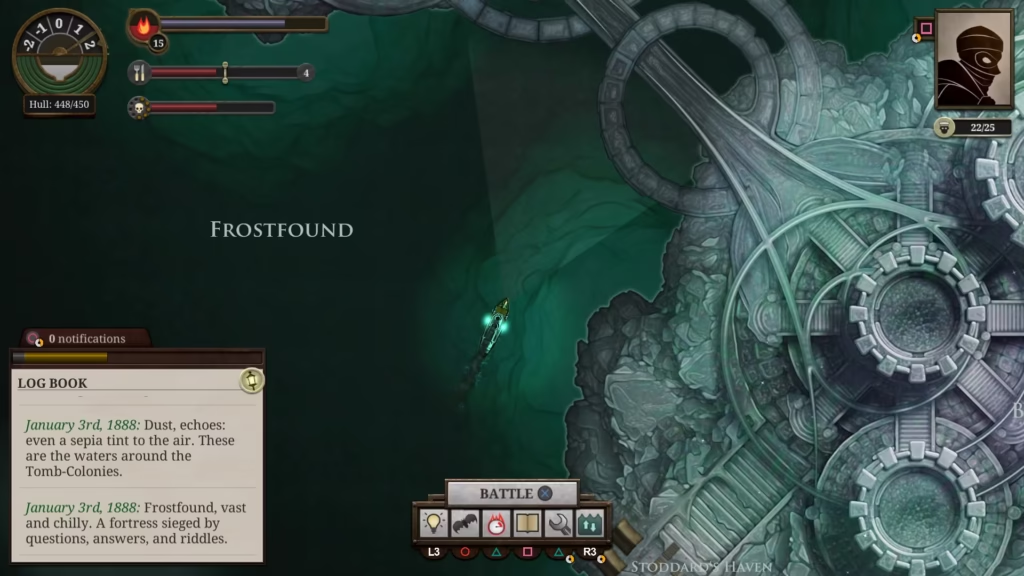
Sunless Sea is a Gothic exploration RPG set on the Unterzee, the vast underground ocean beneath Fallen London. As the captain of a Victorian steamship, you hire officers and crew, stock fuel and supplies, trade between ports, pursue stories, and judge how far you can travel before the cost of continuing outweighs the promise of whatever lies ahead.
Sailing takes place in real time, but Sunless Sea is driven less by navigation or combat than by the decisions surrounding each voyage. Fuel determines how far the ship can travel, supplies keep the crew alive, and Terror rises as you spend longer away from the relative safety of civilisation. A promising detour can leave you without enough resources to return home, while a seemingly minor encounter can develop into a story that follows the captain for hours.
Death is built into that structure. A lost captain is gone, but a successor can inherit selected resources and parts of the previous captain’s legacy. Failure therefore has lasting consequences without erasing everything achieved during earlier voyages.
What Is Sunless Sea?
Developed and published by Failbetter Games, Sunless Sea left Early Access on February 6, 2015. It is set in the Fallen London universe, where Victorian London has been taken underground into the Neath and now sits beside the black waters of the Unterzee.
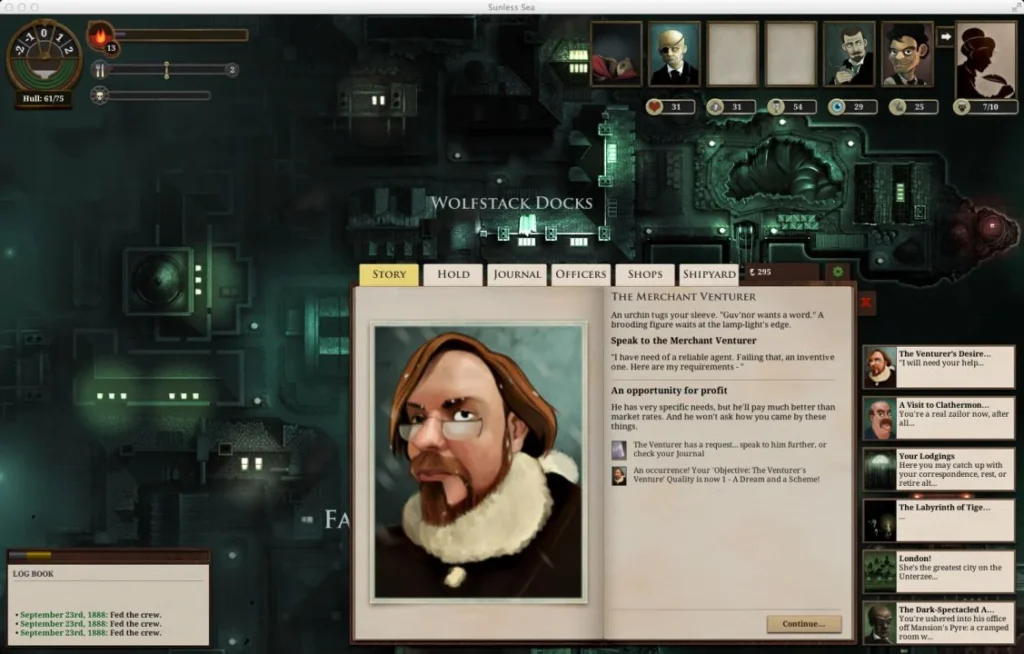
The game’s 350,000-plus words of stories and secrets are not background material added around a conventional RPG. They are a large part of the game itself. Ports, officers, creatures and other inhabitants open written events in which attributes, previous choices and accumulated resources can affect what happens next. Some decisions offer an immediate reward; others begin storylines whose consequences may not become clear until much later.
The basic rhythm is simple: leave London, chart a route through the Unterzee, visit ports, pursue objectives, gather cargo or information, and return before the expedition collapses. What makes that loop work is uncertainty. Reaching another island may advance an officer’s story, reveal a profitable opportunity or produce nothing immediately useful, yet every extra leg of the journey costs resources and exposes the crew to more danger.
Combat with hostile ships and Zee-beasts also takes place in real time, but it is one of Sunless Sea’s less convincing systems. Positioning and equipment matter, yet encounters become predictable compared with the decisions made in ports or while planning a route. The strongest tension comes from deciding whether another journey is worth attempting, not from winning another naval fight.
That distinction is important when deciding whether Sunless Sea will appeal to you. This is a slow, text-heavy RPG built around exploration, resource pressure and incomplete information. Players looking for frequent battles or rapid progression may find long stretches of sailing laborious. Those willing to read closely, plan routes and accept that a captain can die because of one expedition pushed too far will get much more from it.
Setting and Story
The Unterzee gives Sunless Sea most of its identity. Beyond Fallen London’s gas-lit harbour is an underground ocean filled with isolated settlements, strange political arrangements, supernatural creatures and places that rarely work according to familiar rules. The setting is bizarre, but its details are introduced gradually enough that it rarely feels like a catalogue of oddities.
Rather than stopping to explain the world through long stretches of exposition, Sunless Sea builds it through ports, characters and individual incidents. A small request can open a much longer storyline. An officer recruited for useful statistics may eventually become the focus of a personal quest. A location that appears insignificant on an early voyage can matter several hours later because of a choice made elsewhere.
Most of this happens through written events rather than cutscenes. Attributes influence some risky actions, previous decisions can unlock or close options, and officers have storylines of their own. Visiting a new port is therefore interesting less because of conventional loot than because it may contain another piece of the world and another decision whose value is not immediately obvious.
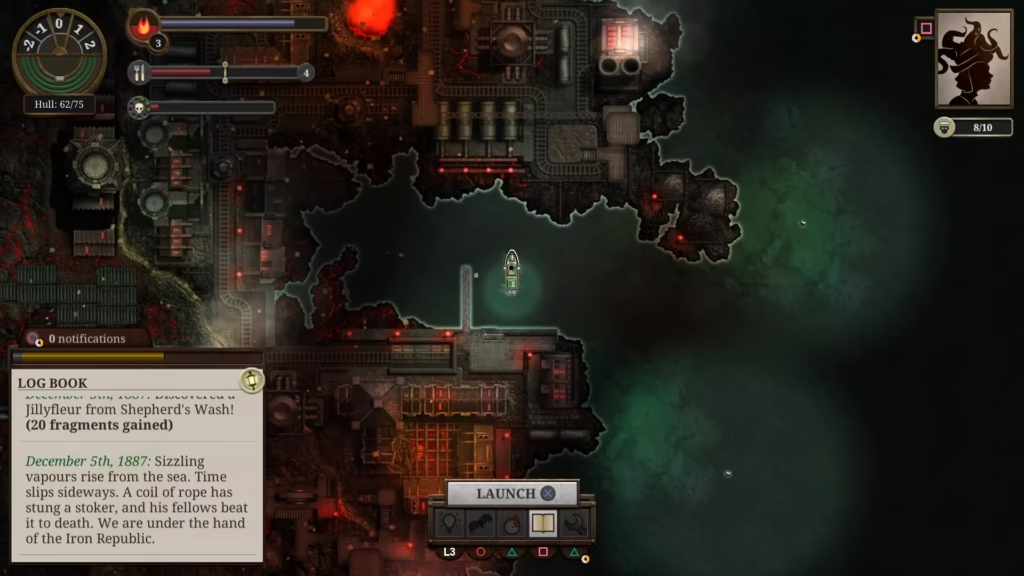
The presentation supports that writing unusually well. Hand-drawn locations, the narrow cone of light around the ship, stretches of black water, distant sound effects and a restrained soundtrack make voyages feel isolated even when little is happening mechanically. Sunless Sea can spend several minutes giving the player almost nothing to do beyond steering toward the next port, yet the darkness and limited visibility make that empty space part of the atmosphere rather than merely dead time.
The limitation appears once familiar routes and stories begin repeating. An event that initially reads like an uncertain narrative decision becomes easier to reduce to its mechanical result after several visits. Once you know that one option produces supplies and another produces a particular story resource, part of the fiction gives way to optimisation. This is one of the clearest weaknesses in a long campaign: authored stories give the Unterzee far more personality than procedural events could, but they inevitably lose some of their effect when the game asks you to revisit them.

Why the Setting Works
Sunless Sea ties its setting to the practical decisions made during a voyage. Reaching a story costs fuel. Staying at sea consumes supplies. Taking a longer route increases exposure to Terror. Cargo occupies space that could have been used for additional provisions. The world is compelling not just because its locations are strange, but because travelling between them forces the player to make trade-offs.
That relationship also explains the game’s deliberately slow pace. Long stretches of sailing give distance weight: a remote port feels remote because reaching it requires time and resources rather than a click on a fast-travel map. The downside is that repeated journeys can become tedious once a route is familiar, particularly because combat and ship handling are not deep enough to make routine travel mechanically interesting on their own.
Sunless Sea is at its best when those limitations and its storytelling reinforce each other. A voyage can begin as an attempt to complete a quest and end with the captain limping back toward London with almost no fuel, an overstressed crew and several new problems created along the way. Its individual systems are relatively simple, and some become repetitive over a long campaign, but together they give exploration consequences that most narrative RPGs never have to account for.
Key Features
Sunless Sea is built around exploration, resource management, narrative choices, character progression and real-time naval combat. None of these systems is especially elaborate in isolation. Their strength comes from how often one decision affects several others: taking a longer route may reveal a new port or storyline, but it also costs fuel, consumes supplies and leaves the crew exposed to rising Terror.
Exploration Mechanics
You control the ship directly as it moves across the Unterzee, clearing fog of war and revealing ports, landmarks and possible routes. Exploration is mechanically simple — there is no complex sailing simulation — but route planning matters because distance has a real cost.
The map is partially randomised rather than completely procedural. Sunless Sea assembles much of the Unterzee from predefined map tiles whose positions can change within specific regions, while some coastlines and locations remain fixed. The ports themselves and their major storylines are authored rather than generated dynamically. This gives successive captains some uncertainty about geography without sacrificing the handcrafted stories attached to individual locations.
That structure works well with the game’s resource economy. A newly revealed port may offer a quest, trade opportunity, officer-related story or useful supplies, but reaching it can leave the ship too far from London to return comfortably. Exploration is therefore less about navigating difficult terrain than deciding how much uncertainty the current expedition can afford.
Fog of war reinforces that tension during early voyages. You may know roughly where you want to travel, but unexplored sections of the map still have to be crossed before their exact layout becomes clear. Later, once common routes are familiar, the same system becomes more about efficient planning than discovery.
Survival Systems: Fuel, Supplies and Terror
Fuel and supplies create the immediate limits of every voyage. Fuel keeps the ship moving, while supplies are consumed by the crew. Misjudging either resource can leave a captain forced to buy provisions at an inconvenient port, abandon a planned route or risk becoming stranded.
Terror creates pressure on a different timescale. It rises as the ship spends longer in the darkness and away from safer locations, with increasingly serious consequences as it climbs. Unlike a simple combat debuff, Terror is tied to events, crew behaviour and the broader risk of keeping an expedition at sea for too long.
What makes these systems effective is that they interfere with otherwise sensible plans. A profitable cargo run may stop looking profitable once the return journey is included. A story objective may be within reach geographically but still be a poor choice if fuel is low or Terror is already high. Sunless Sea repeatedly turns exploration into a question of whether one more destination is worth the margin it consumes.
The survival mechanics themselves are not particularly deep, but they give narrative decisions weight. Without the possibility of running short on fuel, supplies or safe travelling time, many of the game’s choices would lose much of their tension.

Character and Ship Progression
Captain progression is tied to RPG-style attributes used in story events and risky checks. Officers can improve those attributes and also have personal storylines, so choosing who to bring aboard is not purely a matter of statistics.
Progression also happens through the ship. Engines, weapons and other equipment can be upgraded, while larger vessels become available once the captain can afford them. These upgrades change the practical limits of an expedition: a stronger engine reduces travel time, better weapons make dangerous routes more manageable, and additional capacity allows more room for cargo or provisions.
This is more meaningful than a conventional increase in character level because improvements change which journeys are realistic. Early captains often operate close to the limits of their fuel and money, while an established captain can take longer routes and survive encounters that would previously have forced a retreat.
Death remains part of that progression rather than simply erasing it. A successor can inherit selected advantages from a previous captain, including parts of their estate and accumulated legacy. The system softens the cost of failure, but losing an experienced captain can still remove a substantial amount of progress.
Combat
Combat takes place in real time on the same map used for exploration. The ship has to manoeuvre into a useful firing position while keeping hostile vessels or Zee-beasts within weapon range. Equipment, hull strength and engine performance all affect how safely an encounter can be handled.
The real-time system replaced an earlier, more static combat model during Early Access. Failbetter’s overhaul moved fighting directly onto the navigation map and made positioning a larger part of encounters.
Even after that change, combat remains one of Sunless Sea’s weaker systems. Enemy behaviour is relatively predictable, and many fights are decided more by equipment and positioning than by complex tactical choices. PC Gamer’s release review made the same criticism, noting that hostile ships and creatures often become easy to exploit once their movement patterns are understood.
That does not make combat irrelevant. Enemies can block routes, damage a ship badly enough to ruin an expedition or provide useful rewards when defeated. But fighting works best as another source of risk during exploration rather than as a system strong enough to carry the game on its own.
Technical Specifications
Sunless Sea is undemanding by modern PC standards. Its presentation is built around hand-drawn artwork, text, lighting effects and relatively simple real-time navigation rather than hardware-intensive 3D rendering, and the official PC requirements remain very low.
The game is available on Windows, macOS, SteamOS/Linux, iPadOS, Xbox One, Nintendo Switch and PlayStation 4. The specifications below apply to the computer versions sold through Steam.

PC and Mac System Requirements
Steam lists only minimum requirements for Sunless Sea; there is no separate recommended configuration.
| Platform | Minimum requirements |
|---|---|
| Windows | Windows 10 or later; 2 GHz processor; 1 GB RAM; 1280×768 minimum resolution; DirectX 9.0c-compatible graphics; 700 MB storage |
| macOS | Mac OS X 10.6 or later; 2 GHz processor; 1 GB RAM; 1280×768 minimum resolution; DirectX 9.0c-compatible graphics; 700 MB storage |
| SteamOS / Linux | 2 GHz processor; 2 GB RAM; 1280×768 minimum resolution; DirectX 9.0c-compatible graphics with OpenGL Core support |
These requirements are low enough that raw hardware performance is unlikely to be a deciding factor for most current PCs. The more relevant practical issue is operating-system compatibility, particularly on older machines.
Zubmariner DLC
Zubmariner is the major expansion for Sunless Sea. It allows the ship to dive beneath the Unterzee and adds new locations, enemies, wrecks, stories and an additional ambition centred on the search for immortality. The expansion extends exploration rather than replacing the base game’s structure, giving experienced captains another layer of routes and hazards to manage.
Its Steam page lists slightly higher minimum requirements than the base game: a 2 GHz processor, 2 GB of RAM, 1280×768 resolution, DirectX 9.0c-compatible graphics and 1 GB of available storage. The Windows listing still contains the original “Windows XP or later” requirement, but Steam itself has required Windows 10 or later since January 1, 2024.
Zubmariner is worth treating as an expansion to the existing campaign rather than a separate mode. Its new areas add more reasons to plan longer expeditions, while the increased danger and additional resource pressure make mistakes more costly.
Mods and Community Content
Sunless Sea supports community modifications, with much of the game’s non-StoryNexus data exposed through JSON files and an addon structure used for custom content. Community mods have included balance changes, new content and translations.
Modding is a secondary part of the Sunless Sea experience rather than a major pillar of the game. The base game does not depend on community fixes to function, and most players can ignore mods entirely unless they specifically want altered progression, additional content or localisation options.
Because mods can depend on particular game versions or modify persistent data, keeping a backup of important saves is sensible before installing them.
Performance
Sunless Sea does not need extensive graphics tuning. The Steam requirements do not call for a modern dedicated GPU, large amounts of memory or significant storage, and the game’s visual style places far less demand on hardware than a contemporary 3D RPG.
That does not make performance completely irrelevant. Long play sessions in Sunless Sea involve frequent transitions between the world map, ports and text-heavy interfaces, so stability and interface responsiveness matter more than frame-rate optimisation. On a machine that comfortably meets the official requirements, however, performance should not be one of the main factors in deciding whether to play the game.
For this review, the more important technical consideration is compatibility rather than graphical performance: Windows users need Windows 10 or later for the current Steam client, while Linux users require OpenGL Core support.
Price, Editions, and Similar Games
Current Price and Where to Buy
At the time of writing, Sunless Sea is listed at $18.99 on both Steam and GOG for the PC version. Zubmariner, the game’s major expansion, is sold separately for $10.99.
Steam also offers a Sunless Sea + Zubmariner bundle, making it the most straightforward option for players who already know they want the expansion. A broader Fallen London Bundle combines Sunless Sea, Zubmariner, Sunless Skies, and Mask of the Rose, although its value depends on whether the other Failbetter games are of interest.
GOG sells the base game and Zubmariner separately and provides DRM-free installers, which is useful for players who prefer to keep an offline copy without relying on a launcher.
Prices vary by region and can change during promotions, so the figures above should be treated as a snapshot rather than permanent list prices.
Sales and Value
Sunless Sea is old enough to receive substantial discounts during major storefront promotions. Its historical Steam low is well below the current list price, so players who are not in a hurry can reasonably expect sales to offer a better entry point than buying at full price.
The more useful question is whether Zubmariner is worth adding. The expansion is not required to understand the base game, and new players can comfortably start without it. Its value is stronger for players who already enjoy long expeditions and want another layer of exploration, because it extends the existing campaign with underwater routes, new locations, stories, and additional risks.
For a first playthrough, the base game is therefore enough to judge whether Sunless Sea’s slow pacing and text-heavy structure suit you. If they do, Zubmariner adds meaningful content rather than functioning as a cosmetic extra.
Similar Games
Sunless Sea overlaps with several other games, but few match the same combination of authored narrative, route planning, resource pressure, and repeated expeditions. The closest comparisons are more useful when based on structure rather than price.
| Game | Main similarity to Sunless Sea | Main difference |
|---|---|---|
| Sunless Skies | Narrative exploration, resource management, Failbetter’s setting and writing style | Faster progression, more developed combat, and a more accessible structure |
| Darkest Dungeon | Attrition, stress, permanent consequences, dark Gothic tone | Turn-based tactical combat and party management are the central systems |
| BELOW | Isolation, exploration, limited resources, hostile unknown spaces | Much less narrative text and a stronger focus on action and environmental navigation |
| Subnautica | Exploration driven by curiosity, survival resources, fear of entering unfamiliar territory | Fully 3D open-world survival with crafting and base building rather than authored interactive fiction |
Sunless Skies is the most direct comparison because it develops many of the same ideas within another part of Failbetter’s universe. It retains story-heavy exploration and resource management but gives combat, movement, and progression a larger mechanical role.
Darkest Dungeon is closer in the way it treats attrition and psychological pressure, although its turn-based combat and party composition make it a very different kind of RPG.
Subnautica and BELOW share Sunless Sea’s ability to make unexplored territory feel dangerous, but both place more emphasis on physical exploration. Sunless Sea remains much more dependent on written events and the consequences attached to them.
For players primarily interested in narrative exploration rather than combat or crafting, Sunless Skies is the closest alternative. For those drawn more to survival pressure, Darkest Dungeon and Subnautica share parts of the same appeal without reproducing Sunless Sea’s structure.
FAQ
What kind of game is Sunless Sea?
Sunless Sea is a narrative exploration RPG set in the Fallen London universe. It combines real-time sailing, resource management, written story events, character progression, permadeath, and naval combat.
Is Sunless Sea difficult?
Yes, especially during the early hours. Fuel, supplies, Terror, money, and ship damage all limit how far you can travel, and a poor route can end with a dead captain or a costly retreat.
Is the map in Sunless Sea randomly generated?
Partly. Many areas of the Unterzee can change position between captains, but the game uses predefined map tiles and authored locations rather than fully procedural generation.
Does Sunless Sea have permadeath?
Yes. When a captain dies, that character is lost, but a successor can inherit selected resources and parts of the previous captain’s legacy. Death sets back progress without always forcing a complete restart.
Is combat important in Sunless Sea?
Combat is part of the game, but it is not its strongest system. Fights with ships and Zee-beasts take place in real time, while the more important decisions usually involve route planning, resources, story choices, and whether an expedition is worth the risk.
Is Zubmariner worth buying?
Zubmariner is most useful for players who already enjoy the base game’s exploration and resource management. It adds underwater travel, new locations, stories, enemies, and another ambition, but it is not required for a first playthrough.
How much reading is there in Sunless Sea?
A lot. Sunless Sea contains more than 350,000 words of stories and secrets, and much of the game is delivered through written events, dialogue, choices, officer stories, and port encounters.
Is Sunless Sea still worth playing today?
Yes for players who enjoy slow, text-heavy RPGs with strong worldbuilding and resource pressure. Its combat and repeated travel can feel dated or repetitive, but the setting, writing, and expedition structure remain distinctive.