
Bellwright Review: Building a Village Into a Rebellion
Bellwright starts with the familiar routine of a survival game: gather wood, find food, craft tools, build shelter. It does not stay there for long. The real point of the game is gradually handing those jobs to other people until a small camp becomes a working settlement capable of supplying soldiers, supporting expansion, and eventually challenging the Crown.
That transition is Bellwright’s best idea. It gives repetitive survival work an endpoint. Chopping wood and collecting flax matter early because there is nobody else to do it; later, the more important problem is whether workers, storage, production buildings, and transport routes are organized well enough to keep the settlement functioning.
The catch is that Bellwright takes its time getting there. Its early hours are heavy on manual gathering and basic construction, the interface still has awkward edges, and melee combat is less polished than the management systems built around it. Once villagers begin taking over routine work, however, the game becomes substantially more interesting.
Bellwright entered Steam Early Access on April 23, 2024 and remains in Early Access as of September 2026. Since launch, Donkey Crew has expanded the game with new settlement systems, animal husbandry, fishing, trading, the Halmare Isles expedition, construction tools, performance improvements, and console versions.

Premise and Setting
Bellwright takes place in Karvenia, a fictional medieval kingdom ruled by the Crown. The protagonist was framed for the murder of the Prince and sentenced to death. Years later, an assassination attempt and the contract carried by the attacker draw them back to the land they fled.
The personal investigation gradually becomes a rebellion. Progress involves earning the trust of villages, recruiting people, developing settlements, building military strength, and liberating territory from Crown control. The official premise therefore gives the settlement systems a purpose beyond simply constructing a bigger base.
The story is functional rather than the main attraction. Quests provide reasons to visit settlements, clear enemy camps, improve reputation, and push into new regions, but Bellwright spends far more time on production and management than on tightly scripted narrative sequences.
That distinction matters. Players approaching it as a medieval story RPG are likely to find the pacing slow and many objectives utilitarian. Recent reviews have also criticized the frequency of gathering, construction, and camp-clearing objectives. The narrative works better as a framework for the sandbox than as the reason to play it.

Core Gameplay Loop
Bellwright’s routine changes significantly over the course of a campaign.
At first, most work is manual. The player gathers wood, stone, ore, flax, food, and other materials; constructs the first buildings; crafts equipment; hunts; explores; and takes jobs from nearby villages.
This opening can be laborious. Inventory space is restrictive, several important technologies arrive only after research, and early construction requires more direct handling of materials than the later settlement game suggests. A 2026 PS5 review from TheSixthAxis singled out the inventory, construction process, resource bottlenecks, and unusually slow opening as major sources of friction.
Recruitment is the turning point.
Villagers can take responsibility for gathering, crafting, construction, logistics, and other jobs. As the population grows, Bellwright moves away from asking whether the player personally has enough wood or flax and toward asking whether the settlement can produce what it needs without constant intervention.
A typical campaign therefore shifts between:
- recruiting villagers with useful skills and knowledge;
- assigning workers to gathering, production, construction, and logistics;
- building workshops, storage, housing, farms, and other infrastructure;
- researching new technology and equipment;
- completing quests and increasing reputation with neighboring villages;
- equipping followers and organizing military squads;
- fighting bandits and Crown forces;
- expanding the economy enough to support further liberation.
The payoff comes when systems begin supporting each other. One recruit can remove a repetitive gathering job from the player’s routine. Better production provides stronger equipment. Better-equipped fighters make harder territory manageable, while expansion brings access to more workers and resources.
Bellwright is therefore less concerned with constant survival pressure than the genre label might imply. Food, resources, weather, and winter matter, but the longer-term challenge is creating an organization that no longer requires the player to perform every basic task personally.
Settlement Building and Resource Management
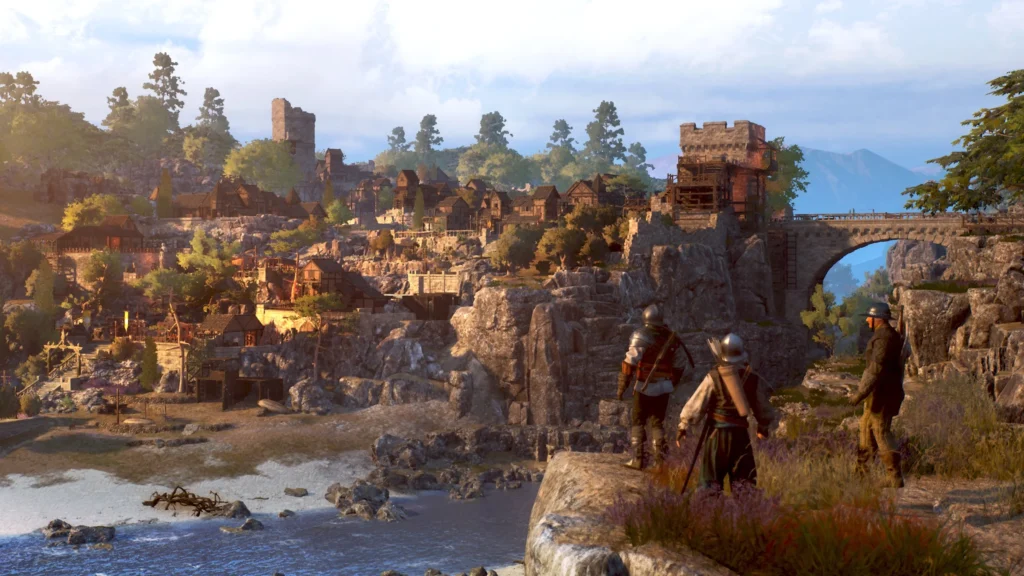
Settlement management is the strongest part of Bellwright.
NPCs are not decorative residents. Workers gather resources, craft items, construct buildings, move materials, and perform jobs connected to their skills. Their professional knowledge also matters to progression, since access to parts of the technology tree depends on having people with the appropriate expertise.
That makes recruitment a strategic decision rather than a simple population counter. A new villager can improve the settlement immediately through labor while also opening paths to more advanced production.
Logistics become more important as settlements grow. Workshops need inputs, construction sites need materials, and workers spend time moving between jobs and storage. A poor layout can turn what looks like a resource shortage into a transport problem.
Bellwright does not use the rigid residential, industrial, and commercial zoning of a traditional city builder. Placement still matters because distance affects how efficiently workers move through their routines.
The 2026 Summer Update improved this side of the game considerably. Planning mode now allows buildings and decorations to be laid out before resources are committed, while player-built roads can connect to the existing road network and support travel signs.
Automation is also where Bellwright’s technical weaknesses matter most. Workers can handle an impressive amount of activity without direct supervision, but pathfinding and job logic are not flawless. Official 2026 patches were still fixing NPCs getting stuck, caravan movement, delivery behavior, construction issues, and other AI-related problems.
The practical result is a management game that can feel satisfying when its logistics click and irritating when one worker or route breaks the chain. Bellwright gives the player more freedom from repetitive labor as the settlement develops, but it never becomes a completely hands-off economy.
Combat and Army Control
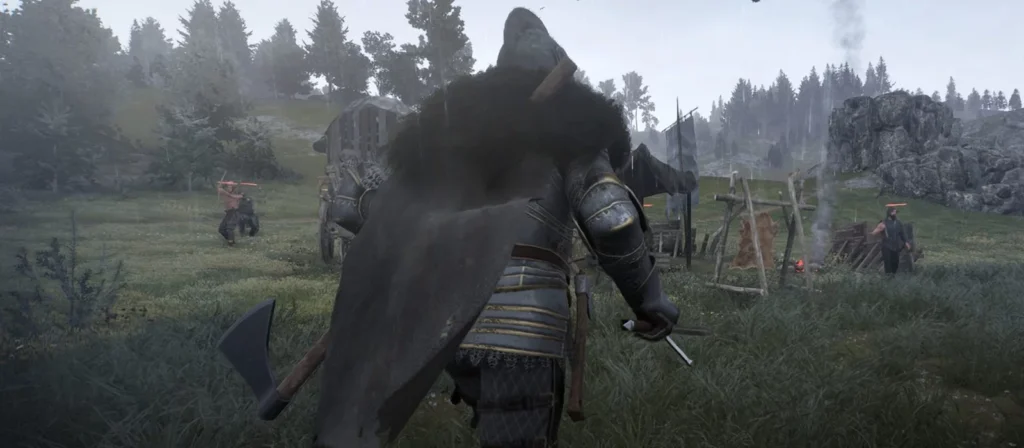
Bellwright uses directional melee combat rather than simple lock-on attacks. Attack direction and blocking matter, with swords, axes, polearms and other melee weapons joined by bows and ranged equipment as progression opens up.
Combat happens in real time. There is no tactical-pause layer for queuing actions.
On paper, the system creates room for timing and positioning. In practice, individual melee encounters are one of Bellwright’s weaker areas. Shielded enemies can make early fights drag, fighting several opponents becomes messy, and recent reviews still describe the system as awkward compared with games built primarily around melee combat.
Bellwright becomes more convincing when combat is treated as part of the settlement economy rather than the main attraction.
Followers can be armed, trained, organized into squads, and brought into larger engagements. The Summer Update improved squad cohesion over long distances and made units easier to control from the map.
This connects military strength directly to production. Weapons, armor, food, and manpower all have to come from somewhere. Expanding an army is therefore partly a logistical problem: the settlement must be productive enough to supply it.
Enemy encounters include bandits, brigands, Crown forces, hostile wildlife, and other threats, but Bellwright does not depend on an elaborate catalogue of specialist enemy classes. Preparation, equipment, numbers, and the ability to support recruited fighters matter more than enemy gimmicks.

The Slow Early Game
Bellwright’s largest barrier is how long it takes to reach its best systems.
Early progression asks the player to gather large quantities of basic resources while working with limited inventory space and a relatively primitive technology set. Construction is deliberately hands-on before enough workers are available to take over.
That design creates a clear sense of improvement later — automation feels useful because the player remembers doing those jobs manually — but the contrast comes at a cost.
TheSixthAxis found the opening slow enough to remain a major problem for almost ten hours and criticized both inventory restrictions and inconsistent UI behavior. Games Asylum reached a similar conclusion after roughly 20 hours, describing Bellwright as a long-term game where an hour of play can produce relatively little visible progress.
Players who enjoy gradual production games may see that pace as part of Bellwright’s appeal. Those who want quick technological progression or frequent combat encounters are more likely to find the opening repetitive.
The important point is that the pace does improve. Once farms, production buildings, storage, and workers begin removing routine tasks from the player’s schedule, there is more time for exploration, quests, military preparation, and expansion.
Co-op
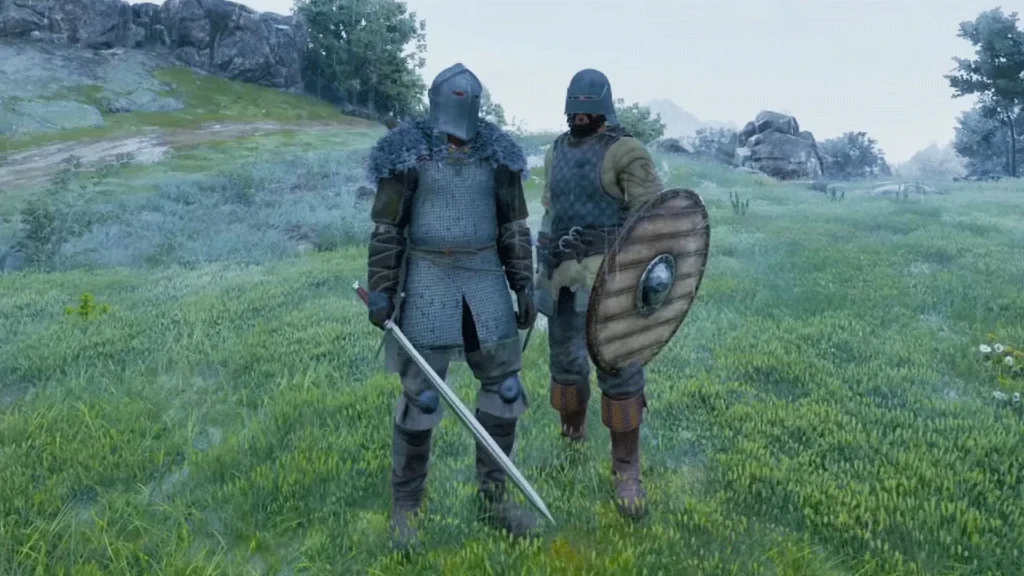
Bellwright supports online co-op as well as solo play.
Steam lists online co-op, and console co-op is now live on PlayStation 5, Xbox Series X|S, and the Microsoft Store. The July 2026 console update added multiplayer support after it missed the initial console launch. PlayStation lists support for up to four online players.
Co-op suits Bellwright because so many early tasks can be divided between players. One person can gather or build while another handles quests, hunting, or combat, reducing some of the downtime that is more obvious in solo play.
It does not remove the management layer. Settlement workers, production, research, and military organization remain central regardless of the number of human players.
Cross-platform play should not be assumed. Donkey Crew said in July 2026 that crossplay was the next major online feature being worked on, but the official update did not announce it as live.
UI, Presentation, and Audio
Bellwright’s presentation is functional rather than lavish. The countryside, forests, villages, seasonal changes, and growing player settlements provide enough visual variation to support long campaigns, but the game’s strongest visual moments tend to come from seeing a settlement expand rather than from individual character animation or cinematic presentation.
The interface has improved during development, yet it remains one of the rougher parts of the experience. Production orders, inventories, settlement controls, and interactions with different workstations can require more menu handling than expected. Recent console reviews have also criticized inconsistent controls and UI behavior.
Voice acting deserves a separate note because Bellwright is still unfinished in this area. Steam’s official disclosure states that generative AI is used during development to prototype voice acting and that professional voice acting is expected for the full release.
That makes the current dialogue presentation another reminder that the PC version is still an Early Access product rather than a finished RPG production.
Performance and System Requirements
Bellwright’s performance picture has changed considerably since its 2024 Early Access launch.
The June 2026 Summer Update moved the game to Unreal Engine 5.7, updated DLSS, FSR, and XeSS, and included a large optimization pass. Donkey Crew specifically said it had addressed micro-freezes affecting large late-game settlements. Subsequent console patches have continued to include stability, stutter, memory, and crash fixes.
That does not make Bellwright free of technical issues, but performance reports from early Early Access should not be treated as representative of the current build without checking their date.
PC System Requirements
| Requirement | Minimum | Recommended |
|---|---|---|
| OS | Windows 10 / Windows 11, 64-bit | Windows 10 / Windows 11, 64-bit |
| CPU | Intel Core i5-8600 / AMD Ryzen 5 3600 | Intel Core i5-13600 / AMD Ryzen 5 5600 |
| RAM | 16 GB | 16 GB |
| GPU | NVIDIA GeForce GTX 1070 8 GB / AMD Radeon RX 580 8 GB / Intel Arc A580 8 GB | NVIDIA GeForce RTX 3060 12 GB / AMD Radeon RX 6600 8 GB / Intel Arc A770 16 GB |
| DirectX | Version 12 | Version 12 |
| Storage | 24 GB | 24 GB |
These are the current requirements listed by Steam.

Price and Platforms
Bellwright costs $29.99 on the US Steam and Xbox stores.
The current versions are available on:
- PC through Steam;
- PlayStation 5;
- Xbox Series X|S;
- Windows through Xbox Play Anywhere/Microsoft Store.
The PS5 and Xbox Series X|S versions launched on June 9, 2026.
Bellwright is sold as a single main game rather than through gameplay tiers such as Standard, Deluxe, or Collector’s editions. Steam currently lists one additional item, the Bellwright Soundtrack, which is free.
Is Bellwright Worth $29.99?
The $29.99 price is easiest to justify for players interested in settlement management.
A campaign can involve several settlements, large technology trees, recruitment, production chains, army development, village reputation, liberation, trading, and the Halmare Isles content. The amount of systemic content is not the problem.
The question is whether the player enjoys the pace required to reach it.
Someone primarily looking for polished melee combat or a tightly written medieval RPG may get less from Bellwright because those are not its strongest areas. Players who enjoy building a workforce, fixing production bottlenecks, and watching a small camp become capable of supporting an army are much closer to its target audience.
At the standard price, Bellwright offers a large sandbox but still carries Early Access roughness. Its value depends more on tolerance for slow progression and management friction than on the raw quantity of content.

Major Updates and Additional Content
Bellwright has expanded mostly through updates to the main game rather than paid gameplay DLC.
The April 2025 Anniversary Update added animal husbandry with chickens, pigs, and cows, alongside fishing, traveling merchants, a library structure, saved squad rosters, and other additions.
Maiden Voyage followed in December 2025. Its main addition was the Halmare Isles, a separate expedition map with new quests, caves, points of interest, creatures, resources, equipment, and structures. The wider update also expanded trading and settlement defenses.
The June 2026 Summer Update concentrated more heavily on the existing game: performance, the early narrative, planning mode, roads, travel signs, squad controls, and other quality-of-life changes.
Steam currently lists no paid gameplay expansions, season pass, progression packs, or cosmetic DLC catalogue. The soundtrack is the only separately listed content and is free.
For an Early Access game, this development history matters more than speculative promises about future DLC. Bellwright in September 2026 is substantially broader than the build that entered Early Access in 2024.
Bellwright Compared With Similar Games
Bellwright overlaps with several well-known medieval and survival games, but each comparison applies to a different part of it.
| Game | Main Focus | Main Difference From Bellwright |
|---|---|---|
| Bellwright | Settlement management, survival, combat, and rebellion | Links NPC automation directly to military and territorial progression |
| Medieval Dynasty | Village building, survival, farming, and life simulation | More emphasis on domestic village life, farming, family, and long-term community simulation |
| Valheim | Survival, exploration, building, and combat | Keeps human players at the center rather than developing an NPC-run production economy |
| Mount & Blade II: Bannerlord | Armies, politics, trade, and territorial warfare | Operates on a much larger military and political scale with far less hands-on survival crafting |
| Kingdom Come: Deliverance II | Story-driven historical action RPG | Focuses on authored quests, characters, and first-person RPG combat rather than settlement management |
Bellwright vs. Medieval Dynasty
Medieval Dynasty is the closest comparison for players interested primarily in building a functioning medieval community.
Both games move from personal resource gathering toward managing other people, but their long-term goals differ. Medieval Dynasty gives greater weight to farming, household life, family, and the settlement itself. Bellwright directs its production economy toward rebellion, armed followers, and territorial expansion.
Bellwright is therefore the more combat-oriented of the two, while Medieval Dynasty spends more of its identity on life simulation and village development.
Bellwright vs. Valheim
Valheim shares gathering, crafting, exploration, construction, combat, and co-op, but its bases are built primarily to support the players themselves. Bellwright eventually asks NPC workers to run large parts of the economy.
The difference becomes obvious later in a campaign. Valheim continues to center progression on what the player explores, crafts, builds, and kills. Bellwright increasingly centers progression on what the settlement can produce without direct involvement.
Valheim completed its 1.0 release on September 9, 2026 and supports 1–10 players.
Bellwright vs. Mount & Blade II: Bannerlord
The Bannerlord comparison becomes useful once Bellwright starts moving from village management toward armies and territorial control.
Bannerlord operates on a much larger military and political scale. Bellwright approaches warfare from the bottom up: gather resources, recruit workers, create production, equip fighters, then expand.
It cannot match Bannerlord’s battle scale or political simulation, but Bannerlord also does not provide Bellwright’s detailed survival-to-settlement progression.
Bellwright vs. Kingdom Come: Deliverance II
The overlap with Kingdom Come: Deliverance II is mostly the medieval presentation and direct control of a character in combat.
Kingdom Come is built around authored characters, historical Bohemia, quests, dialogue, and first-person RPG combat. Bellwright takes place in a fictional kingdom and gives far more attention to construction, workforce management, production, and military logistics.
Someone looking primarily for story and character writing should not treat Bellwright as a substitute for Kingdom Come. Its strengths lie elsewhere.
Who Should Play Bellwright?
Bellwright makes the most sense for players who like progression measured in infrastructure.
Its best moments come from realizing that a task that once consumed several minutes of personal labor is now handled automatically by a settlement that did not exist a few hours earlier. The player gradually moves from worker to planner and from solitary fighter to commander.
That process requires patience.
The early resource grind is heavy, inventory and UI friction can make simple tasks slower than they need to be, worker AI still needs occasional supervision, and directional combat lacks the precision of games designed primarily around sword fighting.
Players who enjoy Medieval Dynasty-style settlement growth but want more warfare have a strong reason to look at Bellwright. Valheim players interested in NPC automation may also find its structure appealing, while Bannerlord players may enjoy seeing military strength built from individual workshops and workers rather than managed from a campaign screen.
Players looking for fast progression, polished melee combat, or a strongly authored RPG story should approach it more carefully.
Verdict
Bellwright is at its best when the settlement starts solving problems that previously belonged to the player. The early hours deliberately make basic work expensive in time and effort; recruiting villagers then turns that labor into an economy, and that economy eventually supports an army and territorial expansion.
Few games connect those stages as directly.
The same dependency on workers and logistics also exposes Bellwright’s weaknesses. AI and pathfinding problems matter because automation is central to the design. Slow early progression matters because the most interesting systems take time to appear. Awkward combat matters less once an army can share the workload, but it never becomes one of the game’s strongest features.
More than two years of Early Access updates have made Bellwright larger and more usable than it was at launch, with Halmare Isles, animal husbandry, fishing, better settlement planning, improved squad controls, console versions, and broad performance work now part of the current game. It is still officially an Early Access title on Steam, and parts of its presentation and interface reflect that status.
For players willing to accept a slow start and some technical roughness, Bellwright has a strong progression arc that few medieval survival games attempt: starting with a character collecting sticks by hand and ending with settlements capable of supplying a rebellion.
FAQ
Is Bellwright still in Early Access?
Yes. Bellwright entered Steam Early Access on April 23, 2024 and remains in Early Access as of September 2026. The game has received major updates covering settlement systems, performance, trading, animal husbandry, fishing, the Halmare Isles, and console support.
What type of game is Bellwright?
Bellwright is a medieval open-world survival RPG with settlement management and army-building systems. It begins with manual gathering, crafting, and construction, then gradually shifts toward recruiting villagers, automating production, organizing logistics, and supporting military expansion.
Does Bellwright have co-op multiplayer?
Yes. Bellwright supports online co-op. Console co-op is available on PlayStation 5, Xbox Series X|S, and the Microsoft Store, with support for up to four online players on consoles. Full cross-platform play between all versions should not be assumed unless officially confirmed.
Is Bellwright mainly a survival game or a settlement-building game?
The early game feels closer to a traditional survival game, with gathering, crafting, hunting, and manual construction. As more villagers are recruited, settlement management becomes the dominant system, with workers taking over gathering, crafting, construction, and logistics.
How good is the combat in Bellwright?
Bellwright uses real-time directional melee combat alongside bows and other ranged weapons. Combat supports larger squad-based battles, but individual melee encounters are one of the rougher parts of the game, especially when fighting shielded enemies or several opponents at once.
Is Bellwright worth $29.99?
Bellwright offers the strongest value for players who enjoy settlement management, production chains, recruitment, and gradual military expansion. Players looking mainly for polished melee combat, fast progression, or a heavily scripted RPG story may find its slow early game and Early Access roughness harder to justify.
What games are most similar to Bellwright?
Medieval Dynasty is the closest comparison for village management and survival, while Mount & Blade II: Bannerlord is more comparable on the army and territorial warfare side. Valheim shares survival, crafting, building, and co-op elements, while Kingdom Come: Deliverance II is much more focused on narrative and first-person RPG combat.